Best ChatGPT dots alternatives in 2026
Dots are OpenAI's always-on personal agents, announced at DevDay on 29 September 2026 and built into ChatGPT. Read on openai.com and the OpenAI Help Center on 5 October 2026: each dot runs on GPT-6 Astra, has its own cloud computer and browser, connects to over 4,000 apps through plugins, and can be messaged in ChatGPT, Slack or Teams. Your first dot is included in ChatGPT Pro — whose plans are $100, $200 and $500 a month — and in Business Premium. At launch, Pro users in the European Economic Area, Switzerland and the UK are excluded.
This page is about OpenAI's dots, not other products called Dots. People looking past them usually want one of four things: the same kind of agent without a $100-a-month plan; an agent they can use where dots have not launched; one they run on their own machine; or — a narrower job — a team that grows a business, with a website, search and social, rather than an assistant for everything. For everyday personal tasks, a general assistant is the right tool, and Muse by Meta is the closest free one. AgentCeres is the pick only for that last job: marketing, growth and a hosted website, from $39 a month.
Free to start · No credit card required
The shortlist
Muse by Meta
Top pickMeta's personal AI agent: its own cloud computer and browser, reached in the Muse app or in WhatsApp, with a small-business mode that connects Facebook, Instagram and Meta ads.
Pros- Free for most use, in Meta's own words — subscriptions exist for people who want more (read 2026-10-05)
- Approval is built in: its business FAQ says nothing publishes, sends or spends without your approval, with an audit trail of what it did
- Muse for Small Business connects tools such as Shopify, Stripe, QuickBooks, Klaviyo and Canva, plus Facebook, Instagram and Meta ads in one step
Cons- Available to people 18 and over in the US and Canada only, per muse.ai on 2026-10-05
- Paid plans are metered in weekly "Muse tokens" — Power at $20/month, Maximum at $100/month, per Meta's Help Center (read 2026-10-06) — so how far each goes depends on the work
- A general agent: muse.ai describes no SEO or AI-answer visibility work, and no hosting for the pages it helps make
- Pricing:
- Free; Power $20/mo, Maximum $100/mo
- Best for:
- US and Canadian users who want a dots-style personal agent without a ChatGPT Pro plan
AgentCeres
A narrower job, labelled honestly: a managed AI marketing team — an AI Growth Officer plus specialists for SEO, GEO, content, social, ads, PR, communities and creators — that also builds and hosts your website.
- Growth Officer
- Research agent
- SEO agent
- Social media agent
- Ads agent
- Influencer agent
- Launch & PR agent
- GEO agent
- Community agent
- Customer feedback agent
Pros- Built for one job: an SEO agent, a GEO agent that checks whether AI answer engines cite you, and social, ads and PR specialists coordinated by an AI Growth Officer
- Builds, publishes and hosts your pages, then reports their visits and form submissions back to you
- $39–$99/mo flat with a 14-day trial and no card — no $100+ assistant plan needed, in eight languages
Cons- Not a personal assistant: it will not sort your inbox, book a table, shop for you or manage your calendar
- Connectors cover marketing tools, not the 4,000+ general apps dots can reach
- No voice calls and no computer of its own for you to open and drive
- Pricing:
- $39–$99/mo flat
- Best for:
- Founders and small businesses whose gap is growth and a website, not personal admin
OpenClaw
The open-source personal assistant you run on your own Mac, Windows or Linux machine, reached through WhatsApp, Telegram, Slack, Signal, iMessage and other chat apps.
Pros- MIT-licensed, with "No subscription. No hosted tier. No token." on its homepage (read 2026-10-05)
- Runs on your machine with your choice of models, so it is not limited to the markets a vendor has launched in
- Stewarded by an independent 501(c)(3) foundation rather than a company
Cons- You install, host and keep it running yourself — there is no hosted version to sign up for
- You pay for whichever model API you connect it to, and set its permissions yourself
- A general runtime: any marketing workflow is yours to build
- Pricing:
- Free (open source); you pay for models and hosting
- Best for:
- Technical users who want a personal agent they own outright
Manus
A general AI agent sold on credits — research, slides, websites and scheduled tasks — with a lower entry price than ChatGPT Pro.
Pros- Paid plans at $20, $40 and $200 a month (4,000, 8,000 and 40,000 credits), with annual billing saving 17% (read 2026-10-05)
- Every plan lists 20 concurrent tasks and 20 scheduled tasks, plus 300 refresh credits a day
- Builds websites and slides as well as research reports
Cons- Credits run out on heavy tasks, so the real monthly cost depends on what you ask of it
- A task runner more than an always-on agent that watches your apps between conversations
- No marketing-specific roles or approval model described on its pricing page
- Pricing:
- $20–$200/mo on credits
- Best for:
- People who want a capable general agent for bounded tasks at a fifth of the Pro price
Side-by-side
| Dimension | Muse by Meta | AgentCeres | OpenClaw | Manus |
|---|---|---|---|---|
| Entry price | Free | $39/mo flat | Free software; you pay for models | $20/mo |
| Where it is available | US and Canada, 18+ | Self-serve signup, eight languages | Wherever you run it | Not stated on its pricing page |
| Everyday personal tasks (inbox, bookings, shopping) | Yes | No | Yes, once you set it up | Task by task |
| SEO, AI-answer visibility and a hosted website | Not described on muse.ai | Yes | Only if you build it | Builds sites; no hosting or SEO agent described |
| Who approves outbound actions | You — nothing sends or spends without approval | You, by default; opt-in Auto mode never covers spend | Whatever you configure | Not described on its pricing page |
What dots do well. They are the most ambitious version of the always-on agent so far: a computer of their own, background "proactive research" restricted to read-only tools, and Custom Rules that let you decide, action by action, whether a dot acts without asking, acts only if you asked for it in the prompt, asks first, or hands the task back to you. OpenAI's own examples include marketing work — revising launch materials when scope changes, drafting social posts from an interview transcript for your approval. If you already pay for ChatGPT Pro outside the excluded markets, try your dot before buying anything else.
A disclosure, and why it matters here. AgentCeres runs each customer workspace on its own instance of OpenClaw, the open-source assistant in this list; what we add is the managed part — the marketing roles, the connectors, the hosting and the approval cards (see AgentCeres vs OpenClaw). So the honest split is by job, not by engine. A general agent can do a marketing task when you ask; a standing team keeps doing it when you don't, with an SEO and a GEO specialist and a site it hosts and measures.
On "ask before acting". Dots, Muse and AgentCeres all default to asking before anything leaves your hands, and that is right for anything public. It has a cost we can measure: in our own production data for 31 August to 4 September 2026, 20 of the 21 approval cards our agents raised were never clicked. Whichever agent you choose, decide up front which routine actions it may take alone — dots do that with Custom Rules, we do it with an opt-in Auto mode that never covers ad spend — or expect finished work to wait in a queue.
How we checked. Read on 5 October 2026: openai.com/index/introducing-dots, help.openai.com ("About ChatGPT Pro tiers" and "Getting started with your dot"), muse.ai and muse.ai/business, openclaw.ai and manus.im/pricing. Muse's paid-plan prices are published on Meta's Help Center ("About Muse subscriptions") rather than on muse.ai; we added them after reading that page on 6 October 2026. For marketing done by people instead, see agencies and freelancers.
What AgentCeres does for you
Three jobs your team takes off your plate, each one you can see working.
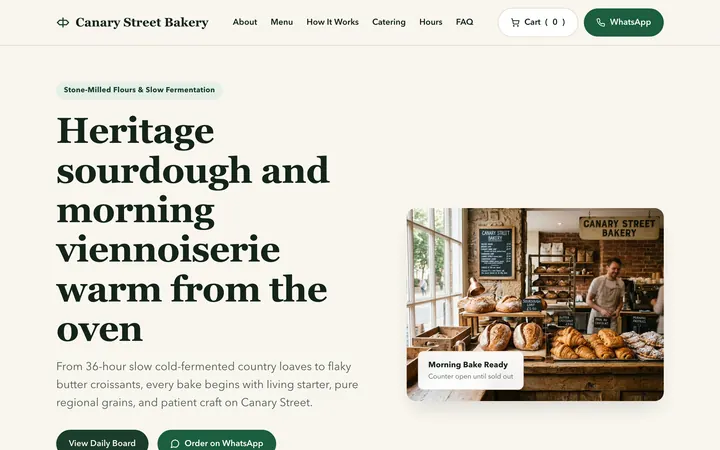
Builds and hosts your website
Describe your business and it builds the site, publishes it, and changes it whenever you ask.
See the AI website builder →FacebookMon 7:30 
The seeded sourdough is out of the oven. Come early, it goes fast.
LinkedInTue 12:00 
Feeding the team on Friday? We cater office breakfasts: pastries, coffee and fruit, delivered before the first meeting.
Plans and posts your social media
Posts and images about your business on one calendar. Each one waits for your approval, unless you turn on Auto mode.
See the AI social media manager →Runs your Google ads
It finds the searches your buyers make, writes the ads, and runs the campaign once you approve the plan.
See the AI ads manager →
Describe your business. Your team takes it from there.
Write a sentence about what you do, or paste your website. In a minute or two your AI growth team is set up and starts on its first piece of research. From then on it works on a schedule, briefs you every morning and brings you drafts to approve.
- 0:00You describe the businessA sentence, or your website address.
- A minute or twoYour team is set upA Growth Officer and every specialist, in your own workspace.
- Minutes laterFirst findings in your chatWhat it learned about your market, with sources.
- Next morning, 8:00Your first daily briefBy email: what moved, and what to do next.
FAQ
- How much do ChatGPT dots cost?
- There is no separate price for your first dot. Read on OpenAI's site on 5 October 2026, it is included in ChatGPT Pro — Pro 100 at $100/month, Pro 200 at $200/month and Pro 500 at $500/month — and in Business Premium, with an allowance for deeper work. OpenAI says more dots, and more speed or work per dot, will be purchasable later. Conversations with your dot do not count toward ChatGPT usage limits; tasks it starts in Codex or ChatGPT Work do.
- Are dots available in Europe or the UK?
- Not on Pro at launch. OpenAI's Help Center says dots are rolling out to Pro users in markets excluding the European Economic Area, Switzerland and the UK, while Business Premium users get them in all supported ChatGPT regions. Enterprise, Edu and Healthcare workspaces can try a beta that is off by default. Muse by Meta is limited to the US and Canada, so in those excluded markets the open-source OpenClaw or a credit-based agent like Manus are the general-purpose options.
- Can a dot do my marketing instead of AgentCeres?
- For individual tasks, often yes — OpenAI's own examples include revising launch materials and drafting social posts for your approval. The difference is shape. A dot is one assistant for everything, steered task by task. AgentCeres is a standing marketing team — an AI Growth Officer plus SEO, GEO, social, ads, PR and community specialists — that builds and hosts your website and keeps working on growth without being asked each time, for $39–$99/month. It never spends money you haven't approved. Inside a plan you approved it can pause, lower a budget or drop a keyword on its own; anything that would spend more or reach new people waits for your approval.
Try AgentCeres for ChatGPT dots alternatives
14-day free trial. From $39/month. Cancel anytime.